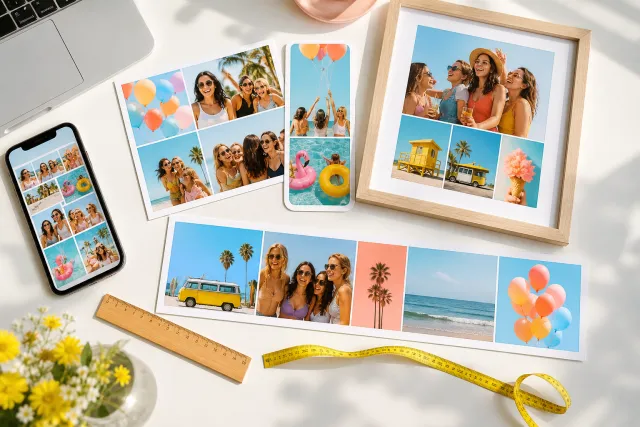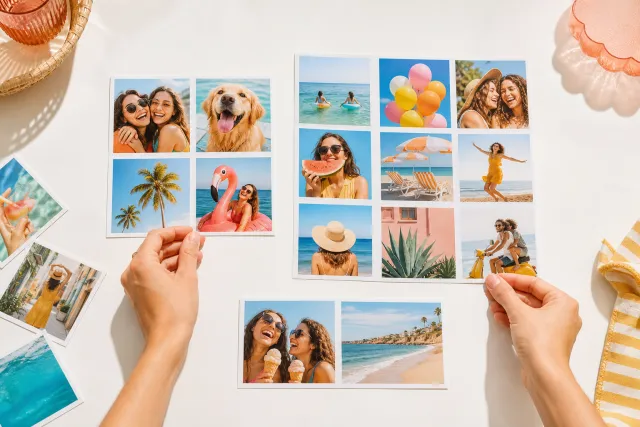
Nine photo collages
At nine cells the individual photographs stop being looked at one by one. The collage becomes a single image made of parts, and that changes what belongs in it.
Square post 1080x1080
Portrait post 1080x1350
Story 1080x1920
A4 print 2480x3508
Up to six photos, a viewer looks at each cell. At nine they stop: the eye takes in the whole rectangle, notices two or three cells, and moves on. That is not a failure of the arrangement, it is what nine cells do, and a collage built for it is a different object from a collage of four. The consequences are worth knowing before choosing this count rather than after.












Made with StudioCollage
Every collage below was made in the editor itself, at full resolution. Open one to start from it.
 Open in the editor
 Open in the editor
 Open in the editor
 Open in the editor
 Open in the editor
 Open in the editor
 Open in the editor
 Open in the editor
 Open in the editor
 Open in the editor
 Open in the editor
 Open in the editor
 Open in the editor
 Open in the editor
 Open in the editor
 Open in the editor
 Open in the editor
 Open in the editor
 Open in the editor
 Open in the editor
 Open in the editor
 Open in the editor
 Open in the editor
 Open in the editor
 Open in the editor
 Open in the editor
 Open in the editor
 Open in the editor
 Open in the editor
 Open in the editor
 Open in the editor
 Open in the editor
1. The whole reads before the parts
Since the eye takes the rectangle first, the collage has to work as a rectangle.
Overall colour matters more than any single photo. Nine photos that share a palette make a strong image; nine excellent photos that clash make a mess, and no arrangement rescues it.
Spread the dark and the bright. Three dark cells in a corner become a dark corner, which the eye reads as a fault in the collage rather than as a property of the photos.
One photo can carry the whole thing if it is given a larger cell. A 3x3 grid with one cell doubled is far stronger than nine equal squares, and it gives the eye somewhere to land.
2. It belongs on paper
Nine cells on a phone leave each face about a fingernail wide. On A3 they leave each face a couple of centimetres, which is a photograph again.
| Where | Nine cells |
|---|---|
| Phone screen | Faces gone. Only shape and colour survive |
| A4 print | Workable. Each cell about 8cm |
| A3 print or larger | Where this count belongs |
| Instagram post | Poor, unless the photos are patterns rather than people |
If the collage is for a screen and the photos have people in it, six is the count, and this is the clearest case on the site where the destination decides the number.
3. What nine photos are for
A year. Nine months, nine events, nine places. The count suits a span of time better than a single occasion.
An everything grid. A holiday, a season, a party, where the point is abundance rather than any individual moment.
A set with a theme. Nine doors, nine dishes, nine of the same thing photographed differently. This is where nine is genuinely better than six, because the repetition is the subject.
4. Make one
Pick a collage above and it opens ready. Look at your nine photos as a block of colour before arranging them: at this count that is what a viewer sees first, and it is the thing you can still change.
Print sizes for the version worth framing, and the large collage guide if nine is not enough.
Questions about 9 photos collages
Is nine photos too many for a collage?
For a phone, yes if the photos have people in them: nine cells leave each face about a fingernail wide. On A3 the same nine cells give each face a couple of centimetres and it works. This is the clearest case where the destination decides the count rather than the photos.
How do I arrange nine photos?
As a block first. At nine cells the eye takes in the whole rectangle before any single photo, so the overall colour matters more than any individual picture and dark cells should be spread rather than grouped. A 3x3 grid with one cell doubled is far stronger than nine equal squares.
What suits a nine photo collage?
A span of time rather than a single occasion: nine months, nine places, nine events. Or a themed set - nine doors, nine dishes, the same thing photographed nine ways - where the repetition is the subject and nine is genuinely better than six.
Should all nine cells be the same size?
Usually not. Nine equal squares give the eye nowhere to land, and one doubled cell fixes that at no cost. The photo that gets it should be the one that still reads at small size, which is rarely the most detailed one.